


- June 7, 2026
- Posted by: Velosi Author
- Categories: HSE, Insights

Introduction
Running a complex industrial operation means managing countless assets at once, which means that process equipment fails, and human decisions miss critical details. Small oversights can turn into expensive downtime or worse, safety incidents. This is where the HAZOP (Hazard and Operability) study becomes invaluable for facility managers and HSE professionals across the oil, gas, chemical, and manufacturing sectors.
HAZOP isn’t new. It’s been a focal point of process safety since the 1970s. Yet many operations still rely on outdated risk identification methods or skip formal safety reviews altogether. The cost? Regulatory compliance penalties, operational disruptions, and genuine safety risks remain undetected.
This guide explains what HAZOP actually does, how it works, and why leading organizations in the UAE and beyond use it to identify hazards before they become problems.
What is HAZOP and Why Does It Matter?
HAZOP stands for Hazard and Operability. It’s a systematic method to identify process hazards, evaluate potential deviations from normal operation, and assess the consequences of those deviations across your facilities, equipment, and systems.
Core Focus
Most incidents don’t happen randomly. They result from deviations, intentional or accidental, from how your process was designed to operate. HAZOP study methodically explores what could go wrong by examining every segment of your operation through structured questioning.
Key Characteristics of Effective HAZOP Studies
A proper HAZOP brings together a professional team: operations staff, engineers, maintenance specialists, and safety professionals. This diversity of experience is the engine that drives discovery. The facilitator uses “guide words” deliberately, prompts like “More,” “Less,” “No Flow,” “Reverse Flow,” and “Contamination” to stimulate team thinking about deviations others might overlook.
For example, asking “What if there’s MORE pressure than expected in the vessel?” forces the team to imagine scenarios like compressor malfunction, isolation valve closure, and ambient temperature changes. Each deviation gets documented with its causes, consequences, existing safeguards, and recommended improvements.

Why HAZOP Works Better Than Checklists
Generic checklists don’t adapt to your specific process design, equipment configuration, or operational reality. HAZOP does. It’s an analytical yet innovative approach led by subject matter experts who know exactly how your facility behaves under stress. A checklist might miss the risk entirely. HAZOP creates a written, auditable trail of what your team examined, what you found, and how you addressed it. Regulators and insurance underwriters respect that documentation.
The Business Impact: What Organizations Gain from HAZOP
- Regulatory Compliance and Risk Management
In the UAE and across GCC markets, ADNOC requirements, fire code compliance, and international process safety management standards demand documented hazard reviews. Formal HAZOP studies create the evidence trail needed for audits and inspections. When regulators ask, “How did you identify this hazard?” you have structured documentation showing a competent team, recognized methodology, and actionable findings.
- Downtime Prevention and Operational Efficiency
Unidentified hazards don’t just create safety risks; they trigger unplanned shutdowns. A pressure relief valve that wasn’t flagged in your safety review could cause a system that shuts down production for days. HAZOP identifies these risks during design or operational review phases, long before they impact revenue.
- Reduced Capital Spending on Reactive Fixes
When hazards are discovered late, during construction, or worse, after an incident, fixing them becomes expensive. Engineering changes mid-project cost 5-10 times more than addressing them before. HAZOP conducted during design or early commissioning phases catches issues when they’re still relatively inexpensive to fix.
- Improved Insurance and Liability Positioning
Insurers and underwriters evaluate your process safety culture. Demonstrating that you’ve conducted formal, documented hazard analysis using a recognized methodology (like HAZOP) directly influences your insurance premiums and claims history. Facilities that invest in proper hazard identification have measurably better safety records.
How HAZOP Actually Works: The Process
- Phase 1: Preparation and Scope Definition
- Phase 2: Team Assembly and Facilitation
- Phase 3: Systematic Deviation Analysis
- Phase 4: Documentation and Action Planning
HAZOP vs. Other Hazard Analysis Methods
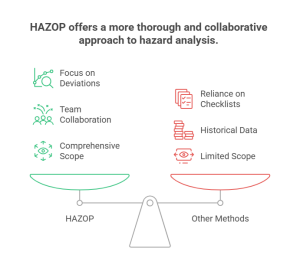
The market offers several hazard identification approaches. Understanding the differences helps you choose the right tool for your situation.
HAZID (Hazard Identification) workshops are brainstorming sessions that cast a wider net, identifying broad hazards quickly. They are useful early in projects but less systematic than HAZOP.
What-If Analysis uses open-ended questioning: “What if the cooling system fails?” It’s flexible but can miss scenarios less obvious to the team.
Fault Tree Analysis (FTA) works backward from an unwanted outcome to identify combinations of failures that could cause it. It’s detailed but requires pre-defined failure scenarios.
HAZOP combines the best of both worlds: It’s systematic enough to identify obscure scenarios, yet flexible enough to explore your specific process complexity. It’s why it remains the industry standard, particularly in oil and gas, chemical processing, and utilities sectors.
Common Challenges in HAZOP Execution and How to Avoid Them
Challenge 1: Inadequate Team Expertise
A HAZOP facilitated by someone without process or industry experience delivers shallow results. The guide words become meaningless prompts that don’t stimulate real thinking.
Solution: Hire experienced, certified facilitators who understand your industry and your specific process. They ask better questions and push teams to think deeper about real risks.
Challenge 2: Time Pressure and Incomplete Studies
Organizations sometimes rush through HAZOP, trying to finish in a day when the process needs 3-5 days. An incomplete analysis means missed hazards.
Solution: Budget adequate time for a thorough study. A well-executed HAZOP saves far more time and money downstream by preventing incidents and avoiding late-stage engineering changes.
Challenge 3: Recommendations That Never Get Implemented
Studies get shelved. Findings don’t translate into action. The entire investment in HAZOP becomes wasted if recommendations aren’t tracked and closed.
Solution: Establish clear ownership of recommendations. Use software tools to track action items, assign responsibility, and report progress. Make HAZOP findings part of your operational and main planning process.
Challenge 4: Not Updating HAZOP When Processes Change
Your process changes include new equipment installed, procedures revised, and staffing patterns shifted. If your HAZOP study is five years old and none of these changes are documented, your risk assessment is outdated.
Solution: Schedule periodic HAZOP revalidations when significant changes occur, or at regular intervals (typically every 3-5 years). Conduct it as an ongoing safety program, not a one-time project.
Real-World Application in UAE Operations
In the UAE’s energy sector and beyond, organizations use HAZOP to manage complex offshore and onshore facilities. The methodology is recognized by ADNOC, major operators, and international clients as evidence of a mature safety culture.
Organizations that use HAZOP systematically report lower incident rates, fewer compliance violations, and more efficient capital allocation toward genuine safety improvements rather than reactive firefighting.
Implementation Structure
- Define Objectives and Scope
What specific process or facility are you studying? What operational modes (startup, normal, shutdown, emergency) matter most? Are you focused on process safety, operability, or both?
- Assemble Your Core Team
Identify the people in your organization who understand your processes best.
- Engage External Expertise
Partner with consultants experienced in your industry sector and your specific process type. They bring methodology, rigor, and credibility that strengthen your findings.
- Plan Your Schedule
Reserve the dedicated time needed, typically 3-10 days, depending on process complexity. Ensure team members are available without competing demands.
- Conduct the Study
Work through your process systematically, applying guide words, documenting deviations, and capturing recommendations.
- Document and Distribute Findings
Prepare a comprehensive report. Share findings with relevant stakeholders: operations, maintenance, engineering, HSE, and management.
- Implement and Track
Assign ownership of recommendations. Use project management tools to track completion. Review progress quarterly.
- Schedule Revalidation
Plan periodic revalidation studies when significant changes occur or at regular intervals (typically every 3-5 years).
Technology Enables Better Outcomes—HAZOP Study Software within VAIL-PHA®
- Modern software platforms make HAZOP more efficient.
- Standardize documentation and ensure nothing gets missed
- Make findings searchable and accessible across your organization
- Integrate recommendations into your asset management and maintenance systems
- Track action items and completion status
- Generate regulatory-ready reports automatically
- Enable easier revalidation by comparing current operations to original study assumptions
Leading organizations increasingly use software-based HAZOP management as part of comprehensive process safety and asset integrity programs. This approach reduces administrative overhead while enhancing data quality and actionability.
Conclusion: Making HAZOP Work for Your Operation
HAZOP is proven. It’s recognized by regulators, embraced by leading operators, and supported by decades of incident data showing that systematic hazard identification prevents accidents and improves operations.
But HAZOP only delivers value when it’s done properly: with competent facilitators, adequate team expertise, efficient supportive software, sufficient time, and genuine commitment to implementing findings. A surface-level study that satisfies a checkbox but doesn’t lead to real improvements is worse than no study at all.
Organizations that treat HAZOP as a core component of their process safety culture, conducting studies when they matter, implementing recommendations seriously, and revalidating regularly as their operations evolve, consistently enhance regulatory compliance and operational efficiency.
If your organization hasn’t conducted a formal HAZOP, or if your studies are significantly outdated, now is the time. The risks of not doing so grow with every operational change, every staffing transition, and every year without expert assessment.
At Velosi, HAZOP follows a constructive methodology to identify potential hazards and to analyze operability criticalities that may result in nonconforming products. The question isn’t whether you can afford to invest in HAZOP. It’s whether you can afford not to.
Enquire Now: https://velosiaims.com/contact-us/
Please contact us for more information and assistance.
Stay connected for more blogs!