

- June 12, 2026
- Posted by: Velosi Author
- Categories: Asset Integrity, Insights, Software

Introduction
Asset Integrity Software in the UAE is critical. The UAE is home to some of the world’s most sophisticated industrial operations. Across the oil & gas, petrochemical, power, utilities, and manufacturing sectors, organizations rely on highly complex, capital-intensive assets that must operate safely, reliably, and efficiently. UAE-based energy companies, manufacturers, and utilities operate some of the world’s most complex industrial assets. From offshore platforms to onshore processing facilities, from pipelines to power generation equipment, managing the integrity of these assets while maintaining reliable operations has never been more critical.
Yet many organizations in the UAE still rely on spreadsheets, fragmented databases, and manual processes to track asset condition, maintenance history, inspection results, and compliance status. The costs of this approach are real: missed inspections lead to equipment failures, inconsistent data creates regulatory compliance gaps, maintenance decisions are reactive rather than risk-based, and institutional knowledge walks out the door when experienced staff leave.
Asset integrity software changes this traditional setback. Modern digital platforms centralize your asset data, automate risk assessments, integrate inspection and maintenance workflows, and provide the visibility needed to make proactive, data-driven decisions about when and how to invest in asset protection.
This guide explains what asset integrity software does, the approach it sets with AI solutions, how it works in practice, and why leading organizations across the UAE are shifting from manual processes to digital asset management solutions.
What is Asset Integrity Software and Why Does It Matter?
Asset integrity software is a digital platform designed to help organizations manage the technical condition and operational safety of industrial equipment and infrastructure throughout its lifecycle. Rather than scattered spreadsheets and paper records, asset integrity software centralizes all information relevant to asset health: design specifications, inspection results, maintenance history, compliance status, risk assessments, and degradation trends.
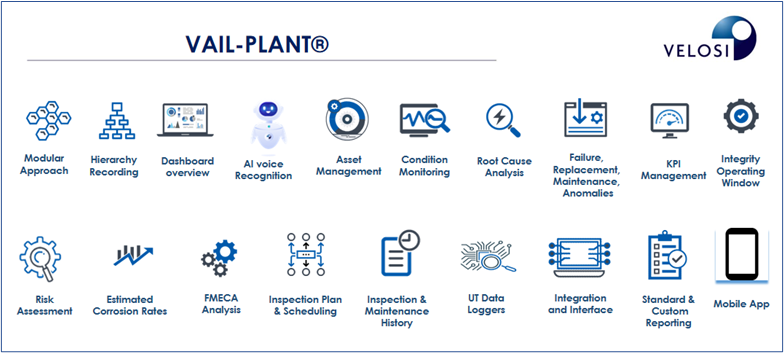
Velosi AIMS® (formerly VAIL-Plant®) – An Authentic Asset Integrity Management Software
Many organizations recognize the need for better asset management, but hesitate because shifting to new software seems overwhelming. VAIL-Plant® addresses this concern by providing a modular, scalable platform built specifically for energy sector operations. Unlike generic software that requires extensive customization, VAIL-Plant® comes pre-configured with risk-based inspection (RBI) methodology, reliability-centered maintenance (RCM) capabilities, and integrated work order management that align directly with how asset-intensive operations actually work.
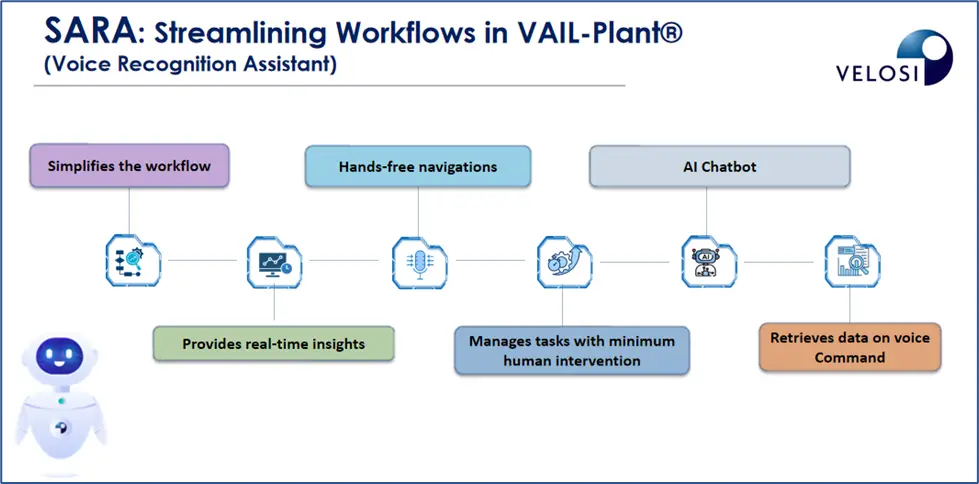
The customized platform centralizes inspection history, maintenance schedules, corrosion monitoring, and pressure equipment tracking in one accessible system with SARA, an AI-Powered voice assistant and chatbot. Organizations like Sonatrach and Mari Energies have used Velosi AIMS® (formerly VAIL-Plant®) to transition from spreadsheet-based asset management to a unified digital approach, improving visibility into equipment conditions across multiple facilities and streamlining decisions about when to prioritize maintenance versus when assets can safely continue operation. Rather than forcing your operational workflow into a rigid software structure, VAIL-Plant® can connect to existing systems, ERP platforms, and document management systems so that data flows naturally between them without redundant entry. For UAE-based organizations managing complex portfolios across onshore and offshore assets, this integration capability means you can implement asset integrity software without disrupting how your teams currently work.
Asset Integrity Software Purpose
The purpose is not simply record-keeping. The purpose is to enable better decisions. When all relevant data is integrated, organized, and accessible, asset managers can answer critical questions that are nearly impossible to answer with manual systems:
- Which equipment is aging fastest and at the highest risk of failure?
- When is the next critical inspection due, and what’s the business impact if we defer it?
- What maintenance activities are actually preventing failures versus just consuming resources?
- Are we in compliance with regulatory requirements and industry standards?
- How much longer does this asset have before replacement becomes more economical than continued repair?
The Shift from Reactive to Proactive
Organizations without asset integrity software are essentially reactive. Equipment fails. You respond. You repair. You move to the next crisis. Costs are unpredictable. Regulatory surprises happen. Staff morale suffers because there’s never enough time to prevent problems, only time to fix them after they have already created business disruption.
Asset integrity software enables a fundamentally different operational model: proactive. You can see degradation trends before failure becomes imminent. You can schedule maintenance during planned downtime rather than emergency shutdowns. You can demonstrate compliance continuously rather than scrambling during audits.
The difference in operational efficiency, safety outcomes, and cost control is substantial.
Core Functions of Asset Integrity Software
Modern asset integrity platforms typically include several integrated capabilities:
- Asset Inventory and Configuration Management
Every asset, piece of equipment, pipe, vessel, structure, and control system is documented in the system. You capture design specifications, materials of construction, design codes, manufacturing records, location, criticality, and current condition status.
This foundation of accurate, accessible information is a prerequisite to everything else the software enables.
- Risk-Based Inspection (RBI) Management
Rather than inspecting everything on a fixed schedule, RBI uses quantitative risk assessment to prioritize inspections based on consequence (what happens if this fails?) and probability (how likely is failure?).
The software then recommends inspection intervals and methods optimized for your risk profile. Critical equipment gets inspected frequently. Low-risk assets get inspected less often. Your limited inspection resources go where they create the most risk reduction.
- Maintenance Planning and Work Order Management
Maintenance work, preventive, corrective, and emergency, flows through the system. Work orders capture scope, resource requirements, estimated duration, and risk, if deferred. Maintenance history becomes a rich database showing what work was done, when, by whom, what was found, and what result was achieved.
- Inspection and Monitoring Data Integration
Inspection reports, analysis, and results are all the information gathered in the field and integrated into the asset’s record in the software.
The system automatically flags data that suggests concern: thickness below minimum acceptable limits, vibration trends increasing, oil analysis showing wear particles. Asset managers can see degradation in progress before it reaches the failure point.
- Compliance and Regulatory Tracking
API standards, ASME codes, CSA requirements, ADNOC directives, and environmental regulations; different assets are subject to different compliance frameworks. Asset integrity software helps you track what’s required, when requirements are due, and whether you’re meeting them.
- Reporting and Analytics
The software generates reports for different audiences:
- Executive dashboards
- Regulatory reports
- Operations reports
Rather than producing a single report format, modern software lets you generate the information your various stakeholders need in formats they find useful.
Why Asset Integrity Software Matters Particularly in UAE Operations
The UAE’s industrial landscape creates specific leads for asset integrity software adoption:
- Regulatory Environment
- Asset Criticality and Environmental Sensitivity
- Skilled Staff Transition
- Capital Optimization in Competitive Markets
- Insurance and Risk Management
Common Barriers to Implementation and How Organizations Overcome Them
Despite the clear benefits, some organizations hesitate to adopt asset integrity software. Understanding common barriers helps you navigate them.
- Upfront Data Migration and Effort
- Change Management and Adoption
- Cost Perception
- System Complexity
- Integration Challenges
Velosi AIMS®: The Right Asset Integrity Software for Your Organization
Velosi AIMS® organizes asset management around specific equipment types and operational needs rather than forcing all assets into a single framework. The platform provides dedicated modules for different asset categories, each built with the specific risks and monitoring requirements that equipment actually faces in operation.
Risk-Based Inspection (RBI) Software calculates inspection priority based on equipment age, operating conditions, and degradation history. Instead of inspecting everything on fixed schedules, RBI ranks assets by consequence and probability of failure. A vessel showing corrosion trends gets inspected sooner than similar equipment with no degradation history. The module recommends inspection methods and timing based on your specific risk profile rather than generic industry guidelines.
Reliability Centered Maintenance (RCM) Software determines which maintenance tasks actually prevent failures versus tasks that consume resources without meaningful benefit. The module analyzes historical failure data to identify which pieces of equipment fail from neglect versus those that fail regardless of maintenance.
Asset Performance Management Software (APMS) tracks how equipment is actually performing in your operation. Compares actual output, efficiency, or throughput against design specifications. When performance drops, the module alerts for equipment degradation or wear that is affecting operations.
Pressurized Equipment Management Software (PEMS) is dedicated to pressure vessels, boilers, tanks, and similar equipment. Tracks design pressure and temperature limits, material specifications, relief valve settings, and inspection results. Automatically flags when thickness measurements approach minimum acceptable limits based on API or ASME standards.
Pipeline Integrity Management Software (PIMSON-Onshore) focuses on land-based pipeline systems. Monitors corrosion patterns, soil stress on buried lines, external interference risks, and coating degradation. Tracks wall thickness trends, dent locations, and cathodic protection effectiveness.
Pipeline Integrity Management Software (PIMSOFF-Offshore) handles subsea and riser pipeline systems with different requirements. Incorporates subsea pressure profiles, riser fatigue analysis from wave motion, platform connection integrity, and deep-water environmental factors. Separate from onshore because the degradation mechanisms and inspection methods are fundamentally different.
Structural Integrity Management Software (SIMS) monitors structural systems like building frames, offshore platform legs, tank supports, and bridge structures. Tracks crack growth, corrosion of structural steel, paint system degradation, and welds under stress. Flags structural components showing stress concentration or fatigue indicators that could lead to catastrophic failure.
Wellhead Integrity Management Software (WHIMS) manages wellhead systems for oil and gas operations. Tracks pressure seals, tubing corrosion, casing integrity, and subsurface well conditions. Integrates wellbore data from drilling records with surface equipment monitoring to give a complete picture of well health.
Electrical, Instrumental, and Rotary Management Software (EIRMS) covers rotating equipment (pumps, compressors, turbines, motors), electrical systems, and instrumentation. Tracks bearing wear indicators, seal conditions, vibration baselines against normal operation, and electrical component degradation, including insulation breakdown.
Pressure Safety Valve & Relief Valve Management Software (PSVMS) is dedicated to relief and safety valve management across your facility. Tracks valve settings, last test and certification dates, performance data from relief events, and seal wear condition. Ensures valves are tested on the required schedule and that test results are documented for regulatory compliance.
Lifting Equipment Management Software (LEMS) manages cranes, hoists, slings, chains, and rigging equipment. Tracks certification status, load test results, wear measurements on critical components, and inspection history. Critical for facilities with frequent lifting operations where equipment failure creates safety and production risk.
Civil Integrity Management Software (CIMS) monitors concrete structures, foundations, civil infrastructure, and buried assets like underground storage tanks. Tracks concrete deterioration rates, reinforcement corrosion, differential settlement, and structural damage from vibration or impact.
Cathodic Protection Management Software (CPMS) monitors systems protecting equipment from corrosion. Tracks the impressed current system status, sacrificial anode consumption rates, potential readings across protected areas, and coating integrity that works alongside cathodic protection.
Flexible Riser Integrity Management Software (FRIMS) manages subsea flexible pipes used in offshore operations. Monitors internal and external corrosion rates, armor wire wear from bending cycles, pressure cycling fatigue in the pipe wall, and connector integrity under tension.
Hull Integrity Management Software (HIMS) tracks offshore vessels and floating facilities. Monitors hull steel thickness, external coating condition, internal corrosion from ballast water or product contact, and structural stress from wave action and operating loads.
Computerized Maintenance Management Software (CMMS) connects all findings to actual work. Converts inspection results into work orders, schedules maintenance around operational windows, assigns resources, tracks completion, and maintains a complete maintenance history. This creates the evidence trail showing what work was done, when, and what condition was found.
Computer-Aided Facility Management Software (CAFM) supports preventive and condition-based maintenance, enhances regulatory compliance, and optimizes resource utilization. CAFM software improves operational efficiency, reduces downtime, and extends the lifespan of critical facilities.
Inspection Scheduling Management Software (ISMS) plans and coordinates inspections across your entire asset portfolio. Determines when inspections are due based on RBI calculations, coordinates inspection teams with equipment availability and planned shutdowns, tracks inspection completion, and ensures results flow back into asset records automatically.
Enterprise Resource Planning Software (ERP) connects VAIL-Plant® to your existing business systems, including ERP, accounting, procurement, and supply chain. When maintenance is scheduled, ERP automatically flags spare parts needed. When inspection results indicate replacement is required, ERP feeds capital cost estimates to financial planning. Spare parts inventory levels adjust based on predicted maintenance demand.
How They Work Together in Practice
Each module feeds data into the core platform, where they communicate seamlessly. An RBI study identifies that a pressure vessel needs urgent inspection. PEMS captures the ultrasonic thickness measurements from that inspection and flags areas approaching minimum thickness. ISMS schedules the next inspection based on what the current inspection found. CMMS creates a work order when remedial maintenance is needed and tracks the repair completion. APMS shows whether equipment performance has improved after maintenance or whether degradation continues despite repairs (indicating design or operational issues requiring different solutions). ERP alerts procurement that replacement parts are needed and feeds capital replacement cost estimates to finance planning.
Historical data accumulates naturally; every inspection result, every maintenance action, every equipment modification gets recorded in one place, tied to the specific asset it relates to. This history becomes invaluable when you need to understand why a particular vessel has required frequent repairs (suggesting design weakness or operational upset).
The software calculates resource planning across your portfolio. Rather than estimating maintenance costs blindly, you can see how many inspection days are needed next quarter, what spare parts inventory you should maintain, which equipment carries the highest consequence-of-failure risk if maintenance gets deferred, and whether your maintenance plan is actually preventing failures or just consuming resources on tasks that don’t prevent anything.
Asset Integrity Software UAE in Practice
Organizations across the UAE’s energy sector and beyond use asset integrity software to manage complex portfolios:
- Offshore operators use it to track inspection and maintenance on platforms exposed to severe corrosion, high operating pressures, and remote locations where mobilization costs are substantial.
- Onshore processing facilities use it to optimize maintenance of rotating equipment, pressure vessels, and structural systems in desert environments where material degradation accelerates.
- Pipeline operators use it to manage the integrity of hundreds or thousands of kilometers of pipe with diverse ages, operating histories, and degradation risk.
- Power generation facilities use it to track thermal equipment, electrical systems, and mechanical drive systems with different lifecycle and maintenance requirements.
- Water and utilities use it to manage aging infrastructure where replacement economics favor life extension and condition-based intervention.
In each case, the software provides the visibility and discipline needed to move from reactive, crisis-driven maintenance toward proactive, risk-based asset management.
Conclusion: Asset Integrity Software as a Strategic Imperative
Asset integrity software is no longer an option or convenience. It’s increasingly a strategic requirement for organizations operating critical industrial assets in regulated environments like the UAE.
Organizations with mature asset integrity platforms outperform their competitors on safety metrics, regulatory compliance, operational reliability, and maintenance cost efficiency. They make better capital decisions because they understand the true asset condition. They prevent more incidents because they see degradation before failure. They operate with greater confidence because they have documented evidence of systematic risk management.
If your organization is still managing critical assets primarily through manual processes, spreadsheets, and institutional memory, the risks accumulate with every passing year: equipment failures become increasingly likely, compliance documentation becomes harder to demonstrate, capital decisions become less informed, and staff turnover increasingly impacts continuity.
The investment in proper asset integrity software implementation pays dividends for years through prevented incidents, optimized maintenance, better capital allocation, and improved regulatory positioning.
Velosi AIMS® (formerly VAIL-Plant® Software), a leading asset integrity software across the UAE, can be an ultimate solution for your business!
Please contact us for more information and assistance.
Stay connected for more blogs!