

- April 13, 2026
- Posted by: Velosi Author
- Category: Asset Integrity

Maintenance programs in complex industries have one fundamental objective, which is to keep the assets functioning at their required capacity without incurring unnecessary cost or unacceptable risk. The reliability-centered maintenance RCM process is the most structured methodology available for achieving that objective systematically and at scale.
The P-F Curve: Understanding How Failures Actually Behave
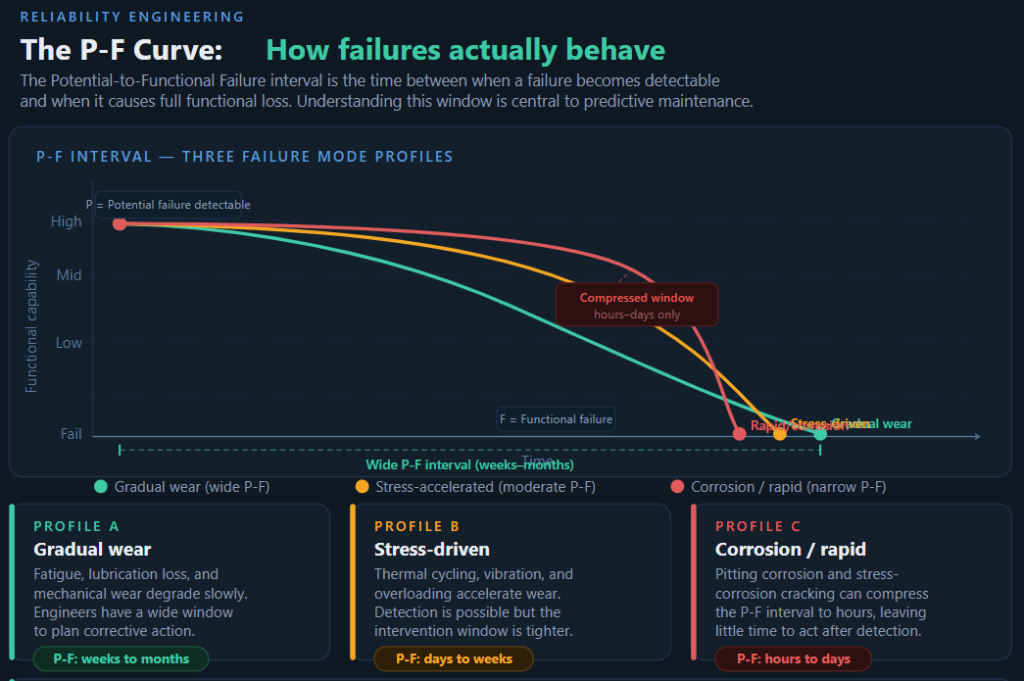
One of the most practically useful concepts in reliability engineering is the Potential-to-Functional Failure (P-F) interval, the time between when a failure becomes detectable and when it causes full functional loss.
Every failure mode has a different P-F curve profile. Some failures develop slowly over months, giving engineers a wide detection window. Others, particularly stress-driven or corrosion-accelerated failures, compress that window significantly, sometimes to days or hours.
This matters directly to maintenance task selection. A condition monitoring task is only viable if it can be performed at an interval shorter than the P-F interval, with enough lead time to act on the finding. If the P-F interval is too short for practical detection, the task provides false assurance, and the RCM process will direct engineers toward a different strategy entirely.
Understanding failure mode behavior, whether a failure is age-related, random in nature, or follows an infant mortality pattern, is what allows RCM to match the right task type to the right failure mode. Time-based replacement only makes engineering sense for failure modes with a clear wear-out characteristic. For random failure modes, it adds cost without reducing failure probability.
The Technical Foundation: What RCM Actually Analyzes
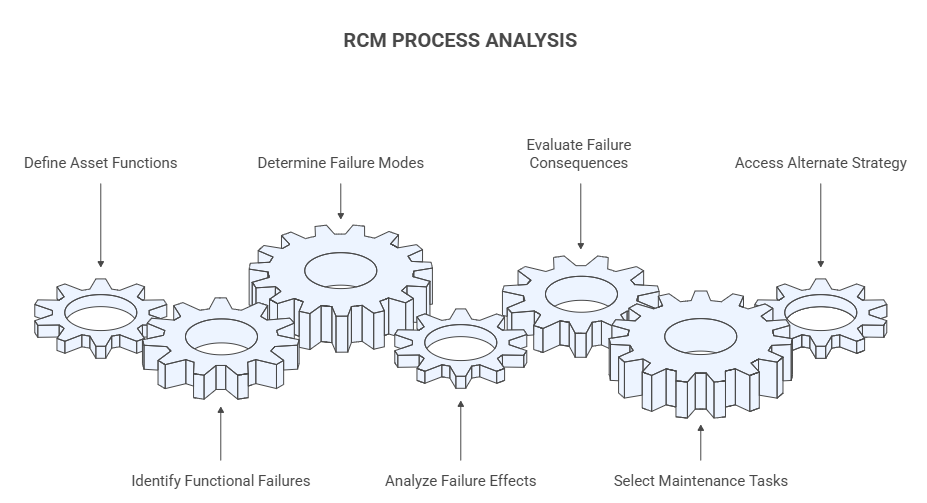
The RCM process is built on a structured set of questions applied systematically to every significant asset in scope. The methodology works through seven core functions:
- Define asset functions: What the equipment is required to do, expressed in measurable performance standards
- Identify functional failures: The specific ways in which the asset fails to perform its intended function.
- Determine failure modes: The physical events or causes behind each functional failure
- Analyze failure effects: What actually happens when each failure mode occurs
- Evaluate failure consequences: Thoroughly evaluate the impact of the failure mode and its associated functional failure (safety, environmental, operational, or economic impact).
- Select maintenance tasks: Matched to failure mode characteristics and consequence category to predict and prevent each failure.
- Access an alternate strategy: Establish any suitable, effective maintenance strategy.
This logic structure is what separates RCM from unpredictable PM scheduling. Every maintenance task must be justified by the failure mode it addresses and the consequence it prevents. Nothing is scheduled by default.
RCM vs. Preventive Maintenance
Traditional preventive maintenance operates on time or usage intervals, replacing the seal every 6 months, approximately. The schedule is applied uniformly regardless of whether the failure mode is age-related, random, or condition-dependent.
RCM challenges that default assumption directly. Research across multiple industries consistently shows that only a minority of failure modes follow a wear-out curve where time-based replacement is genuinely effective. For failure modes driven by stress, corrosion, contamination, or design factors, fixed-interval PM provides limited protection and often introduces its own failure risk through unnecessary disassembly and reassembly.
The RCM process selects the right task type, condition monitoring, time-based replacement, failure-finding, or run-to-failure based on the actual physics of the failure mode, not operational habit or inherited schedules.

Industrial Application: Where RCM Delivers Measurable Results
Oil and Gas Operations
Offshore platforms and pipeline systems carry high consequence-of-failure profiles. RCM is used here to prioritize inspection and monitoring resources on assets where failure carries safety or environmental risk, while deliberately and defensibly reducing maintenance frequency on non-critical equipment.
Power Generation
Gas turbines, steam systems, and rotating machinery in power plants are highly relevant to RCM. The methodology helps operators move from calendar-based overhauls toward condition-based intervals supported by vibration analysis, thermography, and oil sampling data, extending asset life without increasing risk exposure.
Process Manufacturing
In high-production environments, unplanned downtime is directly measurable in lost production value. RCM analysis identifies the failure modes most likely to cause line stoppages and builds targeted strategies around them, which reduces both failure frequency and mean time to repair.
Data-Driven Task Selection
Effective RCM implementation depends on failure data, historical MTBF records, manufacturer failure-mode documentation, field observations from maintenance technicians, and condition-monitoring outputs. This isn’t about algorithms replacing engineers. It’s about making structured decisions based on evidence rather than convention or organizational inertia.
Organizations with mature CMMS or asset management systems can feed historical work order data directly into RCM analysis, significantly improving the accuracy of task interval recommendations and reducing the time required to build a defensible maintenance strategy from scratch.
Implementation Challenges
RCM is demanding at the front end. A complex analysis of a single complex asset can require significant engineering hours before a single maintenance task changes. Common barriers include:
- Incomplete or inconsistent failure history data across asset classes
- Organizational resistance to moving away from familiar PM schedules
- Difficulty sustaining cross-functional participation, operations, maintenance, and engineering plus through extended analysis sessions
- Confusion between full RCM and streamlined variants
The Value Proposition of RCM
When the RCM process is applied correctly, organizations reduce maintenance spend on low-risk assets, concentrate resources where failure consequences are highest, extend asset service life, and build a maintenance strategy that is both defensible and auditable.
For facilities operating under regulatory scrutiny or formal asset integrity management frameworks, that last point alone frequently justifies the full investment.

Ready to Build a Capable Maintenance Strategy with Velosi’s RCM?
Velosi’s RCM strategy applies systematic methodology to determine the most appropriate maintenance tasks to address each identified failure mode and the consequences associated with them.
Velosi bridges the gap between raw data and strategic profitability. Utilizing advanced frameworks like ISO-14224, OREDA, and the SAE JA1011/1012 standards, we transform complex asset information into clarity. This approach ensures our clients can confidently make proactive decisions that reduce costs while staying within acceptable risk parameters
If your current maintenance program is built on inherited schedules rather than failure mode analysis, a structured RCM review is worth the engineering investment.
Contact us to discuss how a structured RCM analysis can be applied to your highest-criticality assets and what a phased implementation roadmap would look like for your facility.
Please contact us for more information and assistance.
Stay connected for more blogs!