



HAZOP Study: A Complete Guide to Identifying Process Hazards and Protecting Your Operation
- June 6, 2026
- Posted by: daniabasit
- Categories: HSE, Insights

Introduction
Every day your industrial facility operates without a significant incident is a victory—and a testament to the work of engineers, operators, and safety professionals who manage complex risks most people never see. But hidden within those systems are scenarios that could injure workers, damage equipment, or disrupt production. The question isn’t if something unexpected will happen. It’s whether you’ve thought through the consequences and prepared adequate safeguards.
This is where a properly conducted HAZOP study becomes essential. A HAZOP study is not a theoretical exercise or a compliance checkbox. It’s a methodical examination of your actual process design and operating procedures, conducted by people who understand your operation, using a disciplined approach that catches risks others miss.
For facility managers, process engineers, and HSE directors in the UAE’s energy sector and beyond, the HAZOP study represents one of the highest-return investments you can make in process safety. This guide explains what HAZOP study delivers, how it works in practice, and why organizations that skip this step expose themselves to preventable risks.
What Makes a HAZOP Study Different From Other Safety Reviews?
Your facility probably has safety procedures, incident response plans, and staff training programs. These are necessary but not sufficient. They address what to do when something goes wrong, but they don’t systematically identify what might go wrong in the first place.
A HAZOP study fills that gap. It’s not a quick safety inspection or a cursory review of design documents. A rigorous HAZOP study is an intensive, multi-day workshop where experienced professionals apply a proven methodology to explore potential process deviations that could occur.

HAZOP Study Overview
A HAZOP study differs from routine safety audits in critical ways:
Scope: While audits verify compliance with existing procedures, HAZOP studies examine whether your procedures address the actual risks present in your process.
Methodology Structure: Audits check boxes. HAZOP utilizes structured, systematic questioning with guide words to stimulate thinking about scenarios that aren’t obvious from casual observation.
Team Expertise: Auditors might spend a day or two at your facility. HAZOP brings together your best internal people—operations, maintenance, engineering—working alongside external experts for several consecutive days.
Outcome: Audits produce compliance reports. HAZOP produces a detailed action plan for specific hazard mitigation, prioritized by risk level, with assigned ownership and timelines.
Analysis: HAZOP results are documented, repeatable, and defensible. If regulators or insurers question your process safety practices, you can point to a systematic study conducted by competent professionals using a recognized international methodology.
Why Organizations Conduct HAZOP Studies
- Design and Engineering Phase
The best time to catch hazards is during the design phase, before equipment is installed and before procedures become embedded in operations. Many organizations conduct HAZOP studies on new processes or major modifications to identify risks before they materialize in the field.
Example: A chemical processor planning a new production line for a specialty product conducts HAZOP to examine reaction dynamics, containment options, and emergency response scenarios. This early identification prevents expensive engineering changes later.
- Operational Revalidation
Your facility has been running for years. Equipment has degraded. Staff have turned over. Procedures have evolved informally. A HAZOP study revalidates that your current operating state is safe and identifies gaps that have developed over time.
Example: An offshore platform reviews its operations after a decade of changes. The study uncovers scenarios that the current emergency response plan doesn’t adequately address, prompting procedure updates and additional safeguards.
- Modification and Debottlenecking
When you change your process upgrade equipment, increase turnover, or alter product specifications, existing hazard analyses become partially obsolete. A focused HAZOP on the modification ensures new risks don’t slip through.
Example: A refinery increases crude turnover through an existing unit. HAZOP identifies consequences for downstream equipment that wasn’t originally designed for the higher flows, prompting capacity upgrades before operational problems occur.
- Pre-Compliance and Regulatory Readiness
In the UAE, standard requirements, fire code compliance, and international contractor certification standards demand formal hazard studies. Conducting HAZOP proactively rather than scrambling to satisfy regulatory requests demonstrates a mature safety culture and strengthens compliance positioning.
- Insurance and Risk Reduction
Insurers evaluate your process safety practices when underwriting coverage and setting premiums. Documentation of formal HAZOP studies using recognized methodology is a clear signal of risk management maturity that can influence coverage terms and costs.
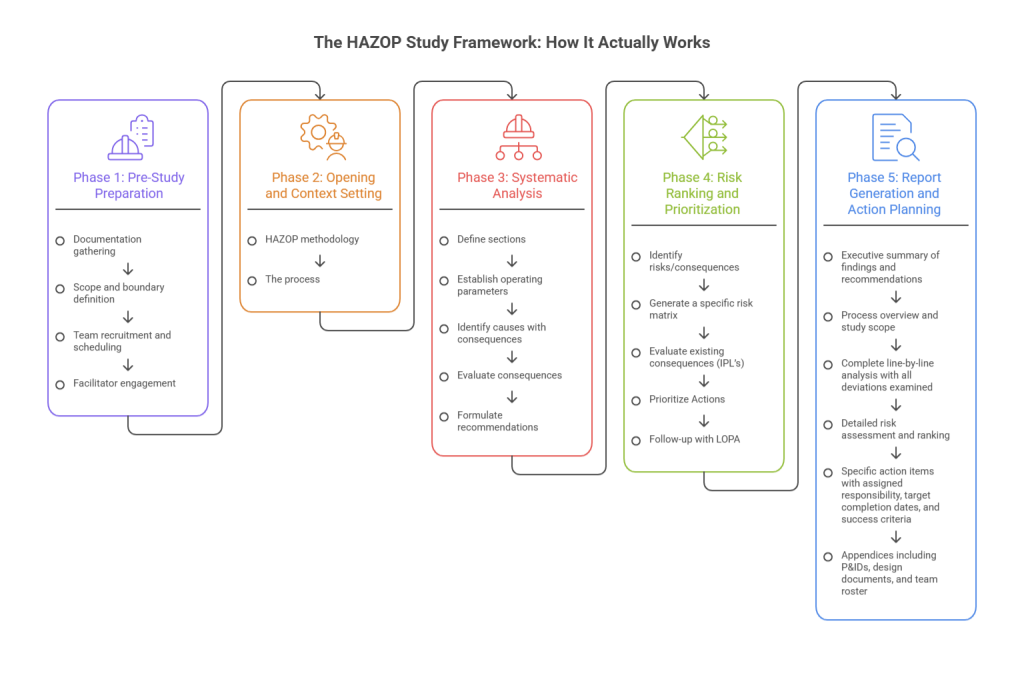
The HAZOP Study Framework: How It Actually Works
A HAZOP study follows a disciplined structure. Understanding the framework helps you prepare properly and maintain a cost-effective methodology.
Phase 1: Pre-Study Preparation
- Documentation gathering
- Scope and boundary definition
- Team recruitment and scheduling
- Facilitator engagement
Phase 2: Opening and Context Setting
- HAZOP methodology
- The process
- The scope and objectives are reconfirmed
This foundation ensures everyone is starting from the same understanding.
Phase 3: Systematic Analysis
- Define sections
- Establish operating parameters
- Identify causes with consequences
- Evaluate consequences
- Formulate recommendations
Phase 4: Risk Ranking and Prioritization
- Identify risks/consequences
- Generate a specific risk matrix
- Evaluate existing consequences (IPL’s)
- Prioritize Actions
- Follow-up with LOPA
Phase 5: Report Generation and Action Planning
- Executive summary of findings and recommendations
- Process overview and study scope
- Complete line-by-line analysis with all deviations examined
- Detailed risk assessment and ranking
- Specific action items with assigned responsibility, target completion dates, and success criteria
- Appendices including P&IDs, design documents, and team roster
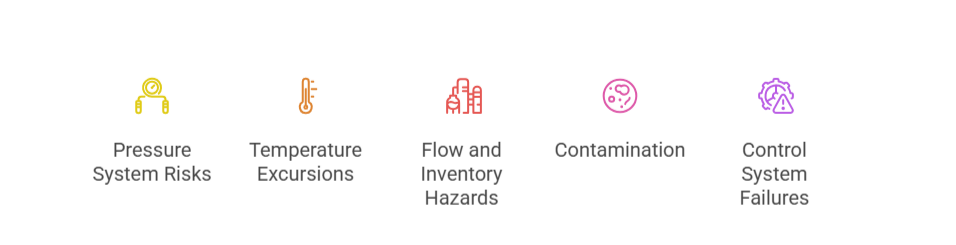
Common Deviations Identified in HAZOP Studies and Why They Matter
Different process types reveal different patterns of risk. Understanding common hazard categories helps you prepare for the types of scenarios your HAZOP study will likely uncover.
- Pressure System Risks
- Temperature Excursions
- Unexpected Flow and Inventory Hazards
- Contamination and Cross-Contamination
- Control System Failures
The Critical Role of Expertise in HAZOP Study Quality
HAZOP studies are only as good as the team conducting them. This is where many organizations miss the value.
- Internal Expertise
- External Expertise
- Team Composition
Critical Success Factors: How Organizations Get Real Value from HAZOP Study
Conducting a HAZOP is easy. Getting real, lasting value from it requires a disciplined yet strategic approach
Adequate Preparation
Too many organizations try to rush the process. They compress a three-week preparation into three days, meaning the team shows up without proper documentation or context. The resulting study is not productive because the team is still learning basic process facts when they should be doing deep hazard analysis.
Solution: Velosi Asset Integrity Limited instead follows a structured methodology to conduct an efficient HAZOP study for leading organizations.
Sufficient Time and Focus
A meaningful HAZOP cannot be squeezed into a two-day offsite while people check email between sessions. The methodology requires sustained attention, continuous conversation, and accumulated team knowledge.
Implementation Discipline
HAZOP findings sit in drawers if implementation discipline is absent. Integrate HAZOP recommendations into your capital planning and operational improvement processes. Review progress quarterly. Make completion of HAZOP actions part of management KPIs.
Periodic Revalidation
Your HAZOP study is partially obsolete if your process has changed significantly. Equipment upgrades, staffing changes, procedure modifications, and operational experience all warrant periodic revalidation.
Real-World Impact: What Difference Does HAZOP Study Make?
Organizations that invest in HAZOP see measurable improvements:
Safety performance: Facilities with documented HAZOP programs report fewer process safety incidents and better near-miss capture rates.
Incident prevention: When incidents do occur, post-incident analysis often reveals that HAZOP had previously identified the scenario, but recommendations weren’t implemented or degraded over time.
Operational reliability: A better understanding of process hazards translates to more stable operations and fewer unplanned shutdowns.
Regulatory positioning: ADNOC audits, insurance reviews, and third-party certifications treat documented HAZOP evidence seriously. It demonstrates a mature safety culture.
Capital efficiency: HAZOP identifies risks early when fixes are less expensive than addressing them late in construction or operation.
Insurance costs: Facilities with strong process safety documentation often qualify for better insurance terms.
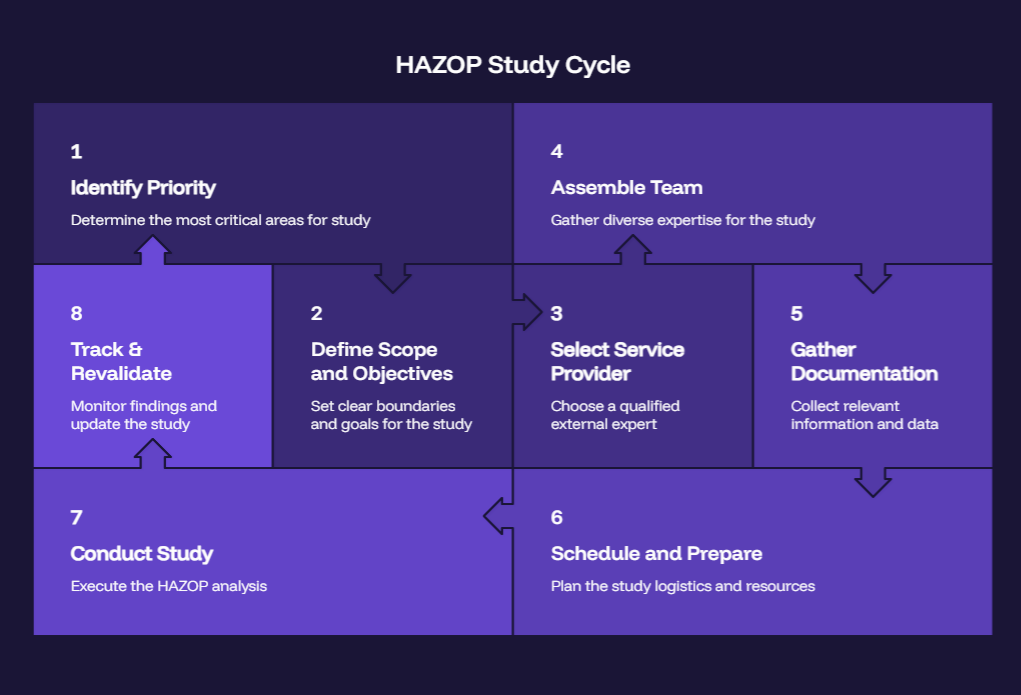
Implementing HAZOP Study in Your Organization: Practical Steps
- Identify Your Priority
- Define Scope and Objectives
- Select Your Service Provider
- Assemble The Team
- Gather Documentation
- Schedule and Prepare
- Conduct the Study
- Track & Revalidate
Conclusion: HAZOP Study as Strategic Investment
HAZOP study is not a compliance burden or a box-checking exercise if done properly. It’s a strategic investment in understanding and managing the actual risks within your operation.
Organizations that conduct rigorous HAZOP studies, implement findings seriously, and treat process safety as a continuous discipline outperform their peers on safety metrics, regulatory compliance, operational reliability, and ultimately, financial performance.
If your organization is operating without a current formal HAZOP study, the risks accumulate with every operational change, every staffing transition, and every year that passes without fresh expert assessment. The question isn’t whether you can afford to conduct a HAZOP study. It’s whether you can afford the consequences of not doing so.
Please contact us for more information and assistance.
Stay tuned for more blogs!