


Asset Integrity Software in Saudi Arabia: A Practical Guide for Oil, Gas, and Petrochemical Operators
- May 14, 2026
- Posted by: daniabasit
- Categories: Asset Integrity, Insights, Software
Introduction to Asset Integrity Software
Saudi Arabia operates some of the largest and most complex industrial assets in the world. From the gas-oil separation plants of the Eastern Province to the petrochemical complexes of Jubail and Yanbu, every pressure vessel, pipeline, and storage tank carries both significant economic value and significant operational risk. Choosing the right asset integrity software is no longer a back-office IT decision. It directly affects safety performance, turnaround duration, and the cost of every audit cycle.
This guide outlines what asset integrity software actually needs to deliver for operators working in Saudi Arabia and what to look for when evaluating a platform.
What an Asset Integrity Software Does: Its Importance
Asset integrity software consolidates inspection history, risk assessments, corrosion data, and maintenance plans for fixed equipment into a single, integrated working environment. Instead of spreadsheets, scanned reports, and disconnected databases, engineers and inspectors work from one source of truth.
A capable platform should cover:
- Risk-Based Inspection (RBI) aligned with API 580 and API 581
- Inspection Data Management for thickness readings, NDT results, and anomaly tracking
- Pipeline Integrity Management for both onshore and offshore lines
- Pressurized Equipment, PSV, and Structural Integrity modules
- Reliability-Centered Maintenance (RCM) and Fitness-for-Service (API 579) assessments

Integration With Other Enterprise Systems
The features list is broadly similar across vendors. The real difference shows up in how the software performs once it is loaded with twenty years of plant data and connected to real operational workflows.
What Makes Saudi Operations Different?
Saudi facilities introduce conditions that generic global platforms often handle poorly.
Stricter compliance frameworks
Operators in the Kingdom work under a layered set of standards: API and ASME codes form the international baseline, but Saudi Aramco’s SAEP procedures, SABIC engineering standards, and ISO 55001 expectations go beyond these minimums. Inspection coverage, NDT certification, and quality escalation workflows must be reflected in the software, not secured on later.
Harsher service conditions
Gulf humidity, chloride exposure, and extreme summer temperatures accelerate external corrosion and corrosion under insulation (CUI) significantly faster than the assumptions baked into many global damage mechanism libraries. Inspection intervals calibrated for temperate climates will leave gaps in Saudi service.
Legacy data that cannot be discarded
Most facilities carry decades of inspection records in mixed formats. Software that cannot adopt, clean, and reconcile that history is not actually solving the problem; moreover, it is not considered the best asset integrity software.
Mandatory integration. SAP, Maximo, and PI systems are widely deployed across KSA operators. Any platform without documented, bidirectional APIs becomes a silo within months.
What to Look for in a Vendor? Asset Integrity Software Demands
A few questions are worth asking before any procurement decision regarding efficient asset integrity software:
- Is the RBI engine certified to API 580, and how is it configured for the specific damage mechanisms common in Gulf service?
- How does the platform handle CMLs when equipment is replaced, re-tagged, or relocated during turnaround?
- Where is the data hosted, and does the arrangement meet requirements for the Kingdom?
- Does the vendor have engineers based in Saudi Arabia who can configure and support the system on-site?
- What is the documented data migration methodology for legacy inspection records?
The answers to these five questions will secure the best from a product demo.

How VAIL-Plant® Addresses Asset Integrity Software Requirements
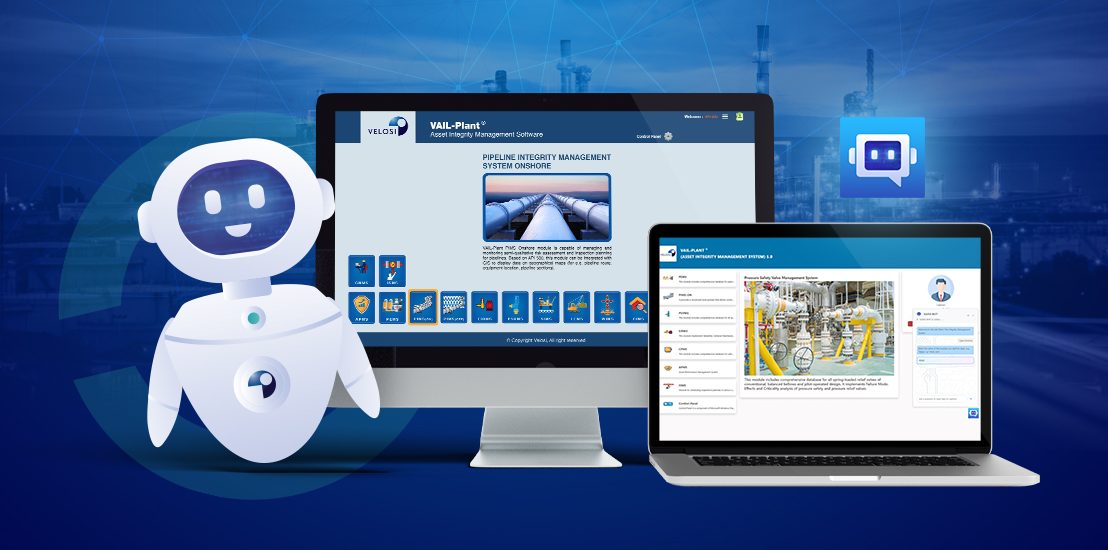
Velosi’s VAIL-Plant® software has been deployed across oil and gas, petrochemical, and power generation operators in Saudi Arabia and the wider GCC for over two decades. The platform is certified to API 580 and ASME B31.8S, with dedicated modules for pressurized equipment (PEMS), onshore and offshore pipeline integrity (PIMS), structural integrity (SIMS), wellhead integrity (WHIMS), PSV management, and corrosion management, all integrated under a single AIMS framework.
The platform’s AI-enabled analytics, digital twin capability, and integration are designed around how Saudi facilities actually operate, and the recent adoption of VAIL-Plant® by Mari Energies for asset integrity and inspection management reflects the continued maturity of the platform in the region.
With a local team based in our Jubail office, Velosi supports clients across the full lifecycle: design verification, in-service inspection, fitness-for-service, and digital transformation. For operators in the Kingdom evaluating asset integrity software, this combination of certified software, regional engineering presence, and forty-four years of energy sector experience is what distinguishes a working solution from a generic platform.
To discuss VAIL-Plant® for your facility, contact the Velosi team.
Know more about our AI-Powered Voice Assistant – SARA
Please contact us for more information and assistance.
Stay tuned for more blogs!